A friend recently asked me, “Is AI a passing fad or is it here to stay?”
In my experience, AI had already made my work more efficient over the last couple of years. I eventually stopped looking things up on Google or Wikipedia and asked AI about every curiosity. And AI is affecting many lives by driving major disruption in business and turmoil in the job market.
AI has awesome powers of analysis, pattern detection, automation, creative generation, and more. You probably noticed Netflix’s new generative AI-powered conversational search tool, which uses OpenAI’s ChatGPT to provide conversational discovery inside the app. You can search Netflix’s media using natural phrases instead of keywords. “I want something funny and upbeat” or “I want something scary, but not too scary, and maybe a little bit funny.” You can refine recommendations in real time based on your mood and tastes.
The Netflix example illustrates how we work with AI today. You can collect and organize information much faster than ever before, and make better informed decisions. Human judgement is the indispensable element. Netflix can filter your options but you still choose what to watch.
Likewise, AI can draft correspondence, reports, articles and more. But you had better review and edit every one of those drafts before you hit Send (or commit and push). Because while AI can gather the facts you need and offer options, it can’t be trusted to make the correct decisions. Not today. Even when AI is accurate — not hallucinating — we must not delegate judgement.
I’ll share a story that illustrates how AI guided me through a repair for which I have no training, and how I iteratively prompted AI so that I could apply prudent judgement at each step.
The setup
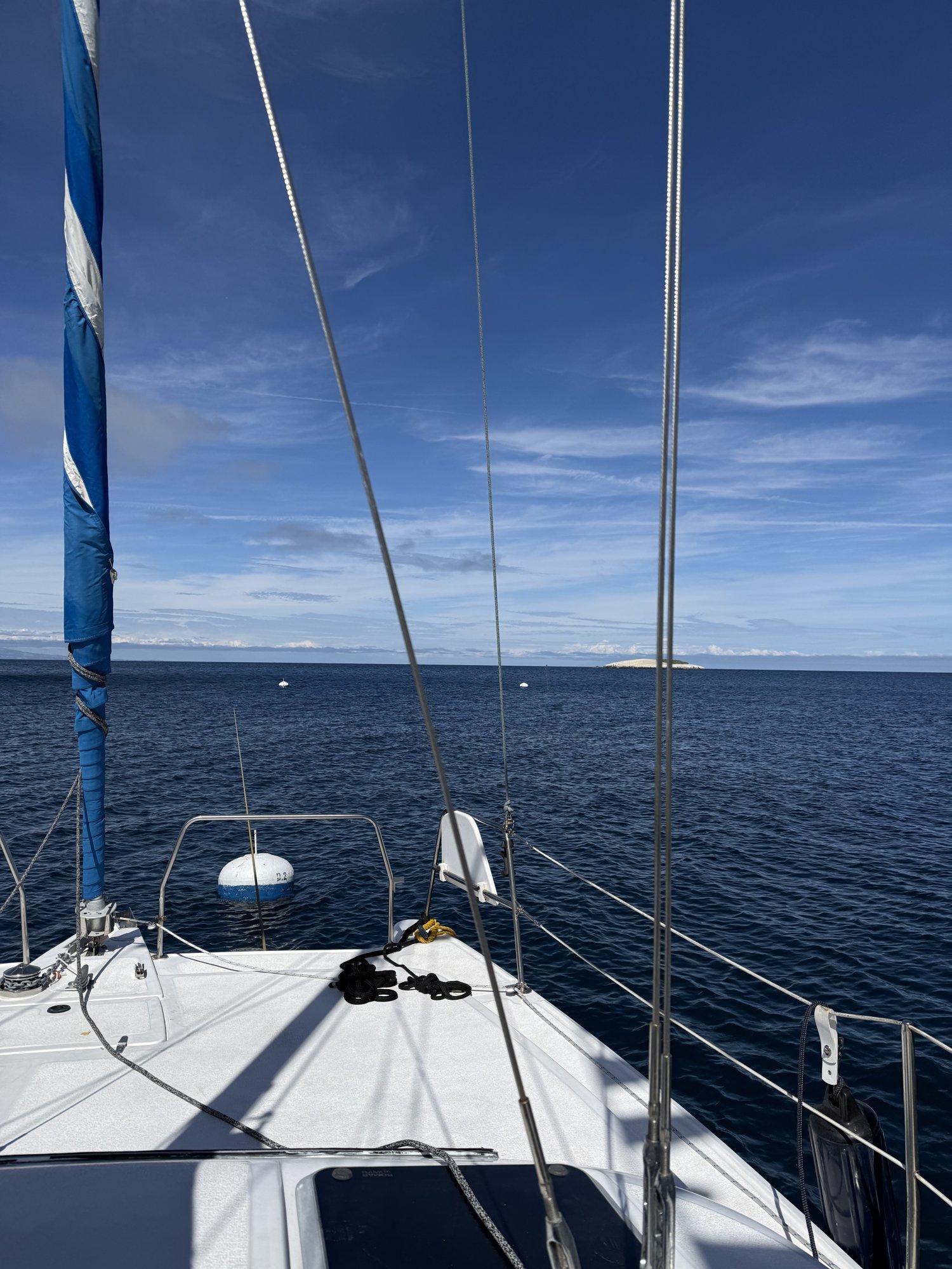
In spring this year, my wife and I joined friends in Long Beach, climbed aboard their 37-foot catamaran, and pointed toward Catalina Island. Our friend Scott had bought and restored the boat over the last three years as it rested on supports in his backyard in the Arizona desert. His adult children, friends, and neighbors helped with various projects such as unloading from the flatbed truck, painting, and myriad repairs. I helped him with a few projects like sanding, replacing windows, and installing a wave break forward of the outboard engines.
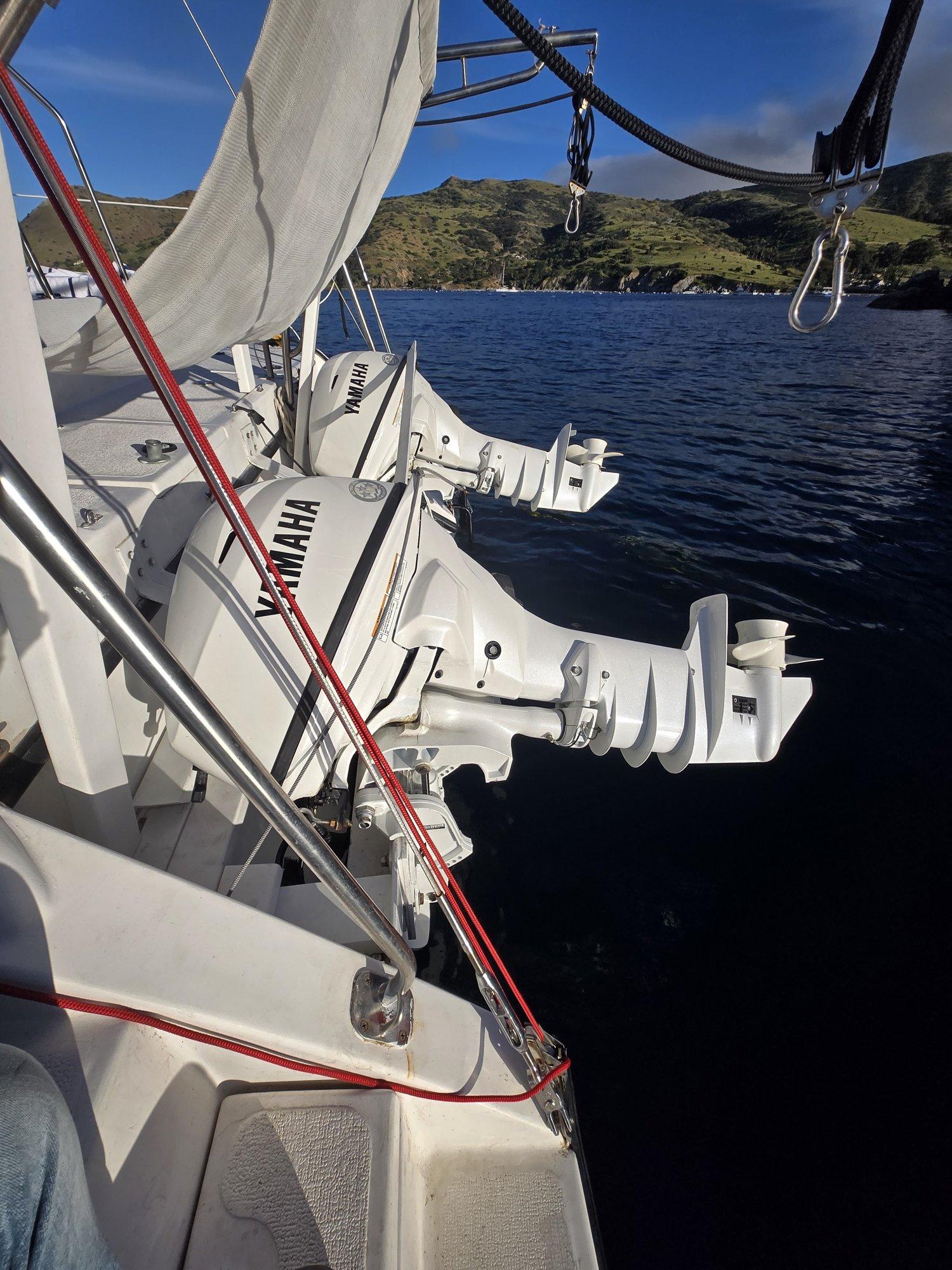
As Scott steered clear of the marina and increased the thrust, one of the twin Yamaha T25 high-thrust four-stroke outboard engines began to violently kick. In open water, there wasn’t much that could be done, so he killed the engine and we covered the 22-mile crossing into the wind with one engine. We moored in Two Harbors and spent the night.
The next day, I climbed into a dinghy and disassembled the prop, hoping we might find something to untangle there. No such luck. The problem was new; Scott had recently sailed without issues, so it made sense that we had picked up some debris in the water. But that wasn’t it. The dinghy bobbed and rolled as I reassembled the propeller and postponed further investigation until we reached the marina again. Once in the marina, the water would be still and we would have access to parts and a mechanic. We relaxed on the boat, explored the island, had dinner at Harbor Reef Restaurant, streamed a movie over Starlink, and played a card game. The return trip would be made on a single engine and with a little wind in the sail.
The diagnostic arc
On our way back the next morning, I spent the hours in conversation with Grok, explaining every symptom in detail and the troubleshooting we had already tried. I am not a marine mechanic. I’m not even a car mechanic. Home repairs are more my speed, but I know just enough to be dangerous. Especially where electricity is involved. I’ve installed many outlets, switches, and ceiling fans and I’ll admit: I’ve electrocuted myself almost every time. My background is in software delivery and leadership: product management, Scrum, SaaS, genomic data, dairy herds, airline reservations, software quality, and the business processes around it all. My professional intuition for outboard-motor diagnostics is exactly zero.
But Grok, running on my laptop in the galley, was eager to have the conversation and deftly analyzed the information I provided.
I described the symptoms to Grok the same way I’d describe a customer-reported product bug at work: what was working, what wasn’t, what I had already ruled out. The engine idled just fine without the load of the propeller. The prop spun freely in neutral. Under load, the engine bucked. No obvious obstruction.
Grok returned four likely causes, ranked by probability: a spun propeller hub, a fuel delivery issue under load, a gearcase problem, and prop ventilation. Each one came with a specific test I could perform with materials I could access once we reached the slip.
The most common cause, Grok said, was a spun hub. I had no idea what that meant, but Grok was helpful in explaining the details and finding diagrams and photos. Once tied in the marina, I climbed back into the dinghy and disassembled the propeller, then reported to Grok that the hub wasn’t slipping. I won’t burden you with the steps. If you’re stranded at sea with the same problem, stop reading this and ask Grok for advice. We even tried a control test, using a spare prop to confirm that it didn’t affect the symptoms.
Each time I supplied Grok with the results of a test or more details about the symptoms, the luculent LLM returned a short list of likely causes, in order from simplest adjustment to most costly repair. At each decision point, Scott and I would discuss the options and choose one. We iterated through the problem, taking input from Grok and making a decision based on cost, our skill level, and available tools. This process circled ever closer to the root cause and the solution. As we got closer, we worried that the gear box would require a costly trip to the mechanic.
We were fortunate in the end. The gear box was malfunctioning but wasn’t damaged. The clutch dog was failing to engage, causing a loud clattering and bucking, because the shift cable needed adjustment. Yes, I learned all these terms from Grok that day. All that was needed was a small adjustment to the barrel nut on the shift cable. Then we tested it under load, forward and reverse, and celebrated our triumph.
What this side quest actually demonstrated
I want to be careful about the lesson, because the wrong version of this story is everywhere on LinkedIn this year. I don’t want you to think AI fixed my friend’s boat.
AI didn’t fix the boat. Scott and I fixed his boat. AI accelerated the diagnosis by quickly providing ranked lists of likely causes and the specific tests to perform for each one. That collapsed what would have been hours of internet searching, YouTube watching, and forum lurking into a focused conversation and a couple of hours of mechanical work.
The work I did was recognizably engineering work:
- I observed carefully — not just the original symptom but the secondary ones that formed a more comprehensive diagnosis.
- I performed the tests correctly and reported the results back in usable form. The prop-hub alignment-mark test, the prop swap as a control, a visual check on the cooling system, et cetera.
- I noticed when something Grok said didn’t quite match what I was seeing, and I pushed back. Grok’s first hypothesis was a spun propeller hub. An alignment-mark test ruled it out. Without that confirmation step, we might have wasted a day and a new prop chasing the wrong fix.
- I sought input from the owner/captain, who represented the client that usually has more domain expertise than the R&D team.
- I evaluated each suggestion against our actual constraints. Grok presented options ranked from simplest adjustment to most costly repair. Scott and I weighed each one against cost, our skill level, and the tools we had on hand, then chose. Grok presented the menu; we chose the dish.
- I knew when to stop diagnosing. Once the linkage held under load, forward and reverse, we tested twice more and called it done. The temptation to keep investigating “just in case” is the cousin of the temptation to over-engineer the system. We resisted both.
That last list is a solid fit with my professional skillset, applied to a domain I’m not professionally trained in. AI supplied the vocabulary, the test sequence, and the ranked list of possibilities. My judgement supplied what AI cannot: the discipline of careful observation, the willingness to test rather than guess, the recognition that the cheap fix is the right one until proven otherwise, and the discipline to stop once the system was working again.
This is the same operating model I’ve written about for my professional work — the hard part of AI-augmented anything isn’t the AI. It’s the human judgement that decides what to ask, evaluates what comes back, knows when the demo-impressive answer isn’t the defensible one, and knows when to stop.
On a 37-foot catamaran tied at a Long Beach marina with a broken outboard, Grok in one hand and a wrench in the other, that thesis happened to be load-bearing in a more literal way than usual.
A few weeks later, when I was asked, “Is AI a passing fad or is it here to stay?” I shared this story and explained that AI will be useful in almost every aspect of our lives. And I warned that while technology can be powerful, it can also be a powerful force of deception and distraction.
So keep a weathered eye, friends.